
Last updated September 20, 2026
Full 25-point door and opener safety check with every visit - springs, cables, rollers, tracks, and your LiftMaster or Chamberlain opener included
You get a price before we start. It does not change when the truck arrives.
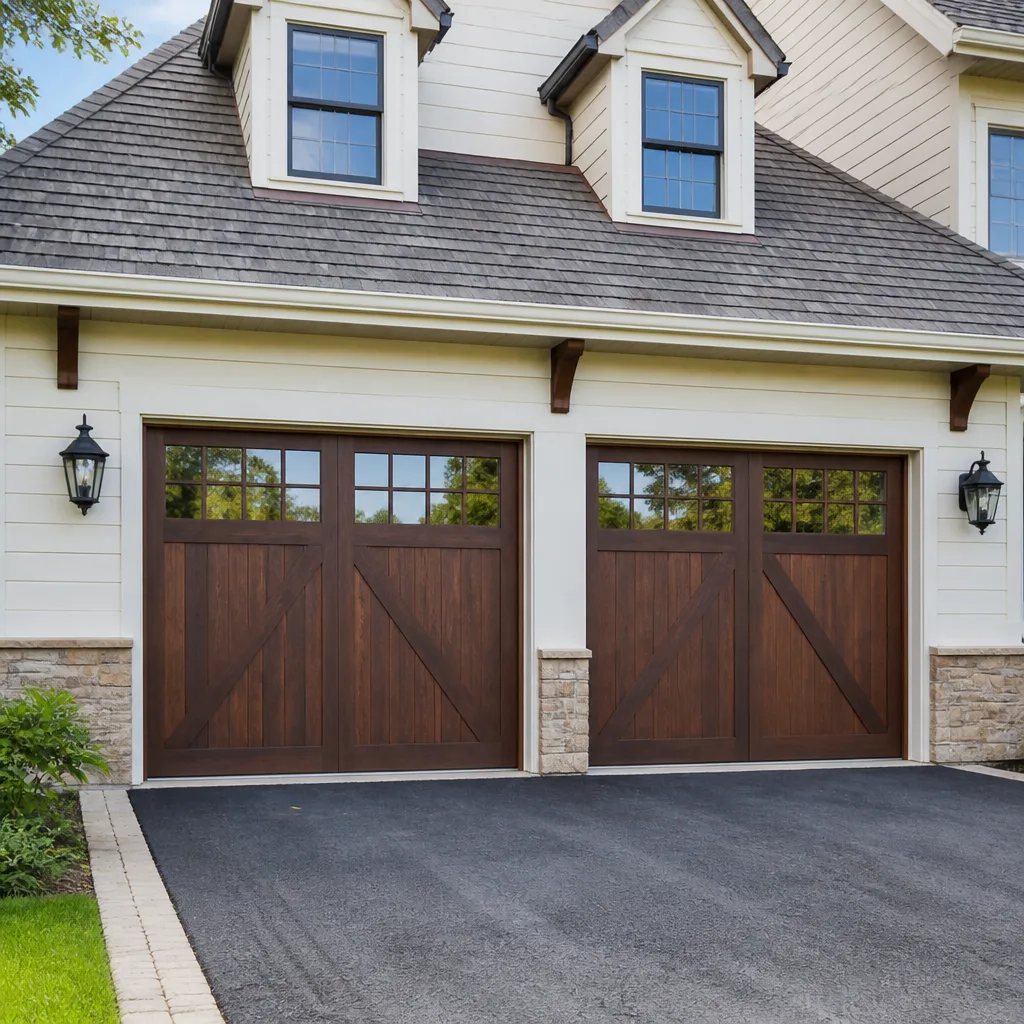
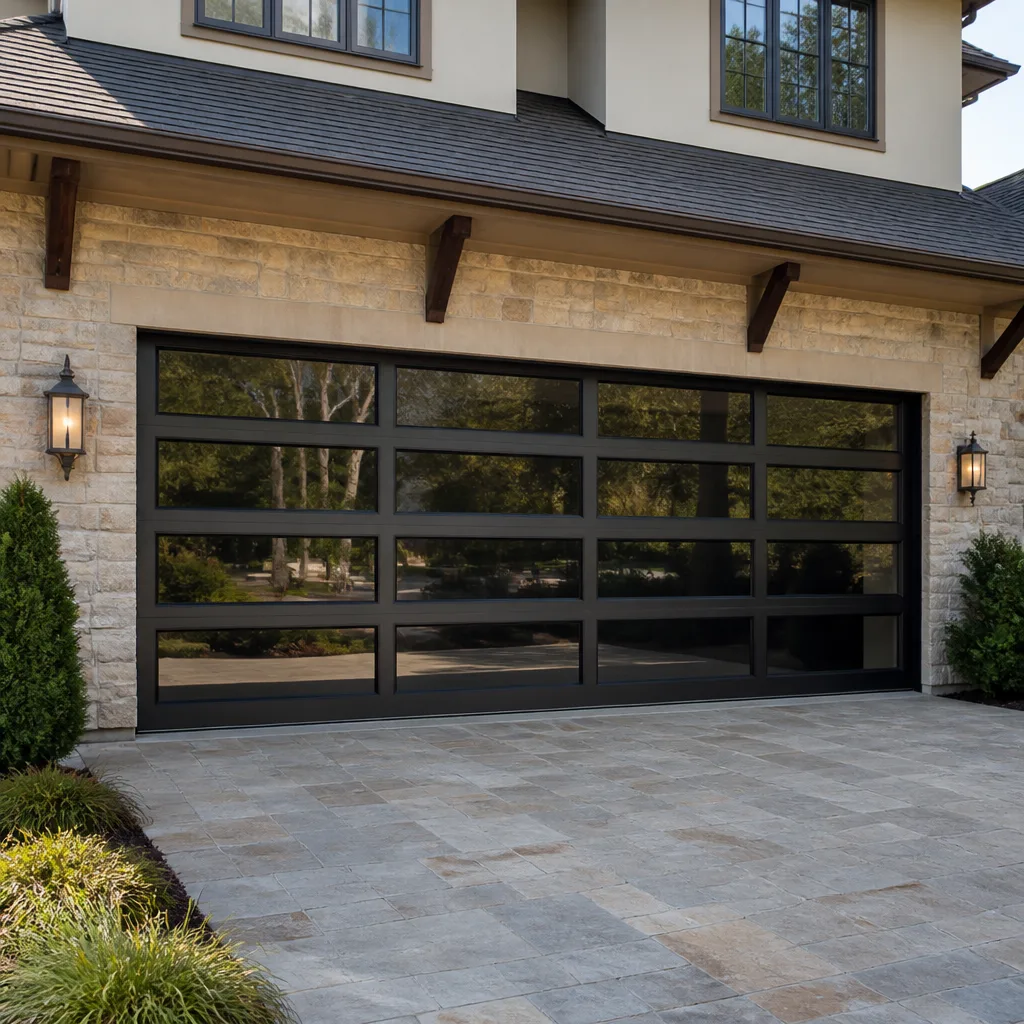
Modern flush
LiftMaster openers
 Before
 After
After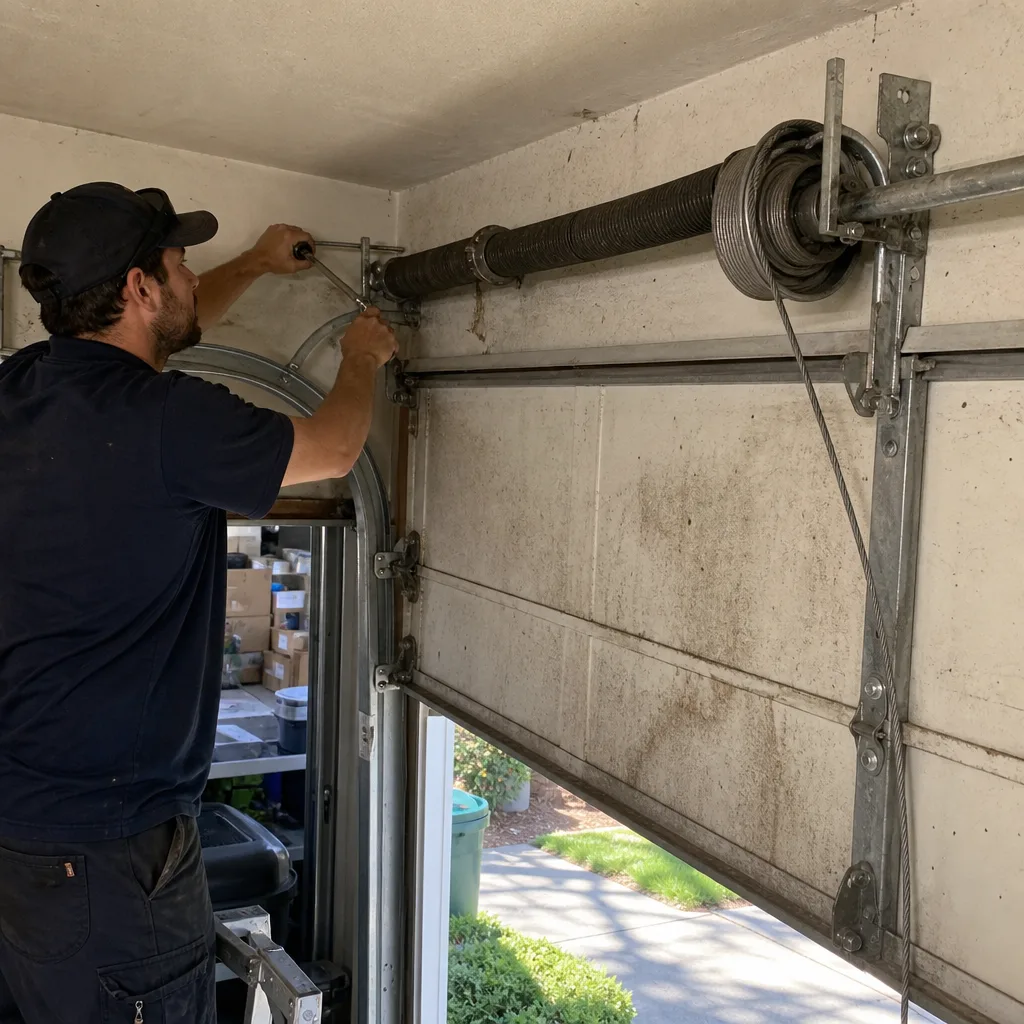 Before
 After
After Before
 After
AfterThe Complete Guide to Garage Door in Sandy Springs
The average Sandy Springs garage door assembly contains 11 distinct parts that can fail independently. Most homeowners can name two of them: the door and the opener. That gap is not your fault. Nobody teaches garage door anatomy, and most people don’t think about the system until a torsion spring snaps at 7:40 on a Monday morning and the car is trapped in the garage. This guide closes that gap, and you’ll find more guides & resources on our blog. You’ll learn what every component does, how long it should last in Sandy Springs specifically, what a fair repair costs in 2026, and what a written price disclosure should contain before you let anyone touch the door.
Quick Answer
A residential garage door in Sandy Springs is a system of 11 components: panels, hinges, rollers, tracks, torsion or extension springs, cables, drums, brackets, weather seal, opener, and safety sensors. Most mechanical parts last 7 to 12 years before they need replacement, though Sandy Springs’s clay-heavy soil and humidity accelerate specific failures, particularly bottom seal degradation and track misalignment. Before hiring anyone in Sandy Springs, you should receive a written price and written scope of work before any work begins, and you should expect a documented photo record of findings when the job is done.
Table of Contents
- The 11-Part Anatomy of a Sandy Springs Garage Door System
- Torsion vs. Extension Springs: Why This Distinction Changes Your Quote
- How Sandy Springs Soil and Humidity Accelerate Door Wear
- What a Written, Pre-Work Price Disclosure Should Contain
- 2026 Sandy Springs Repair Cost Reference Table
- Realistic Lifespans for Every Component
- How to Evaluate Any Garage Door Company in Sandy Springs
- Common Mistakes to Avoid
BeforeAfterThe 11-Part Anatomy of a Sandy Springs Garage Door System
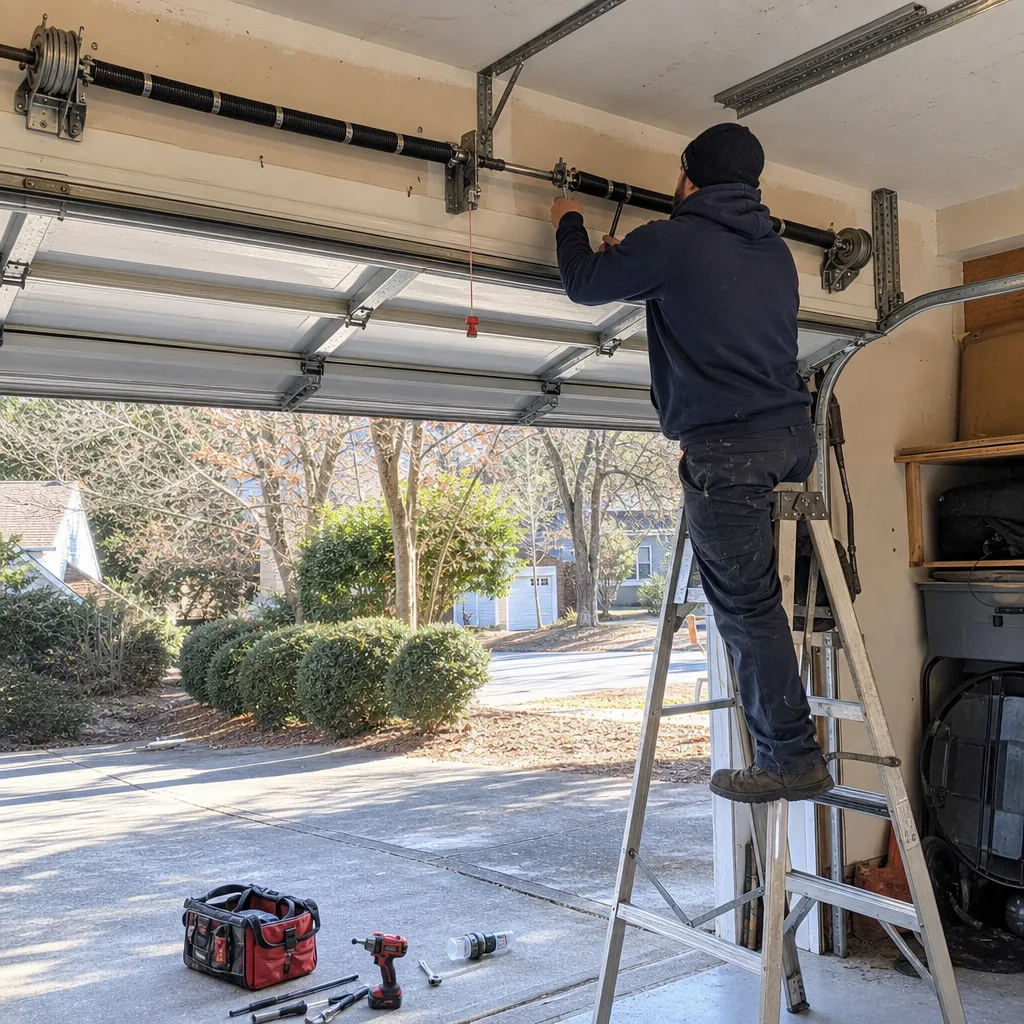
Here is every component that can fail, named in plain language, with its role described in one clause. When a technician tells you the “logic board” is dead, you’ll know exactly what that means and whether the price makes sense.
- Panels - the large horizontal sections that form the door face. They’re typically steel, aluminum, or wood composite. Individual panels dent, rust, or delaminate. Most Sandy Springs homes use steel panels with a polyurethane or polystyrene core for insulation.
- Hinges - the metal joints between panels. They’re numbered by position: hinge #1 sits at the bottom of the door, hinge #3 or #4 near the top. They wear out from use and rust in humid environments.
- Rollers - the wheels that ride inside the vertical and horizontal tracks. Steel rollers last 5 to 7 years in Sandy Springs’s humidity before bearings seize. Nylon rollers last longer and run quieter.
- Tracks - the vertical rails that guide the door up and the curved horizontal rails that carry it into the garage ceiling. They bend out of alignment from impact or foundation movement.
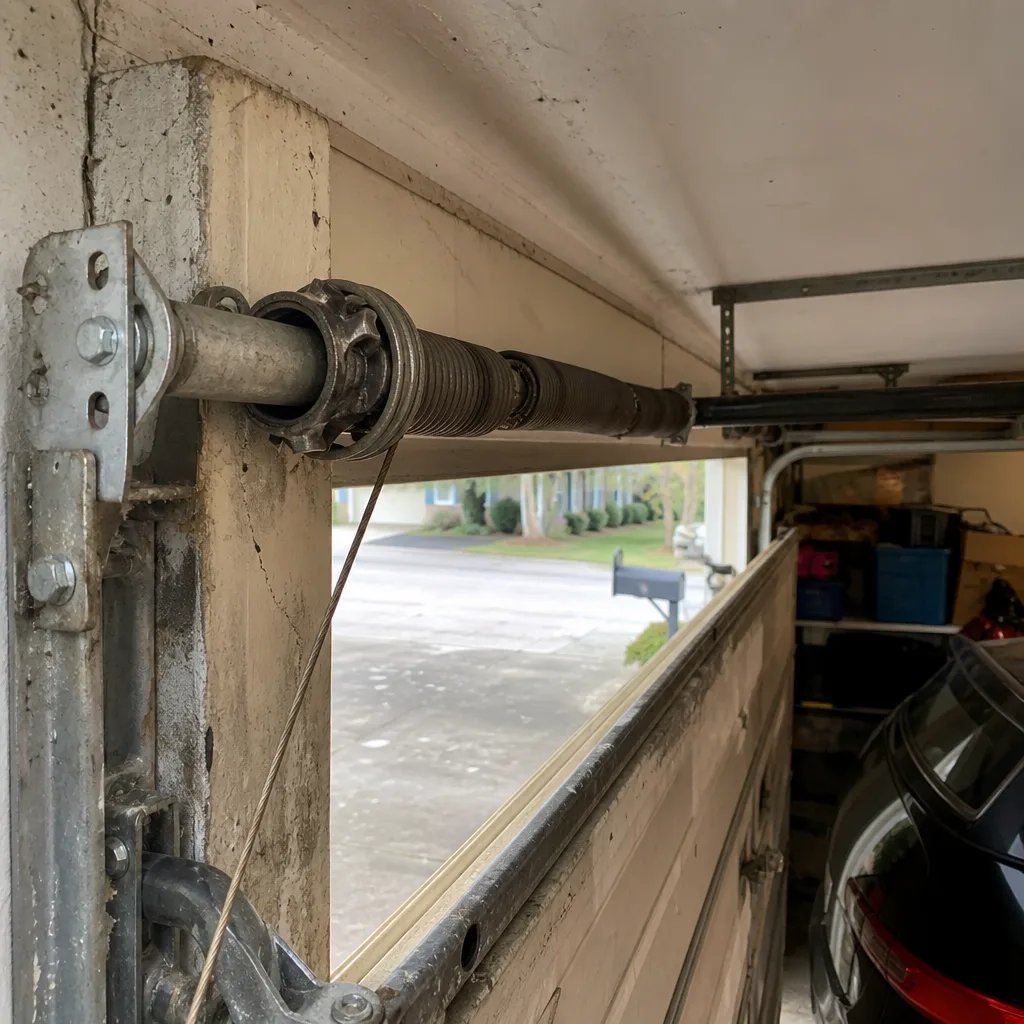
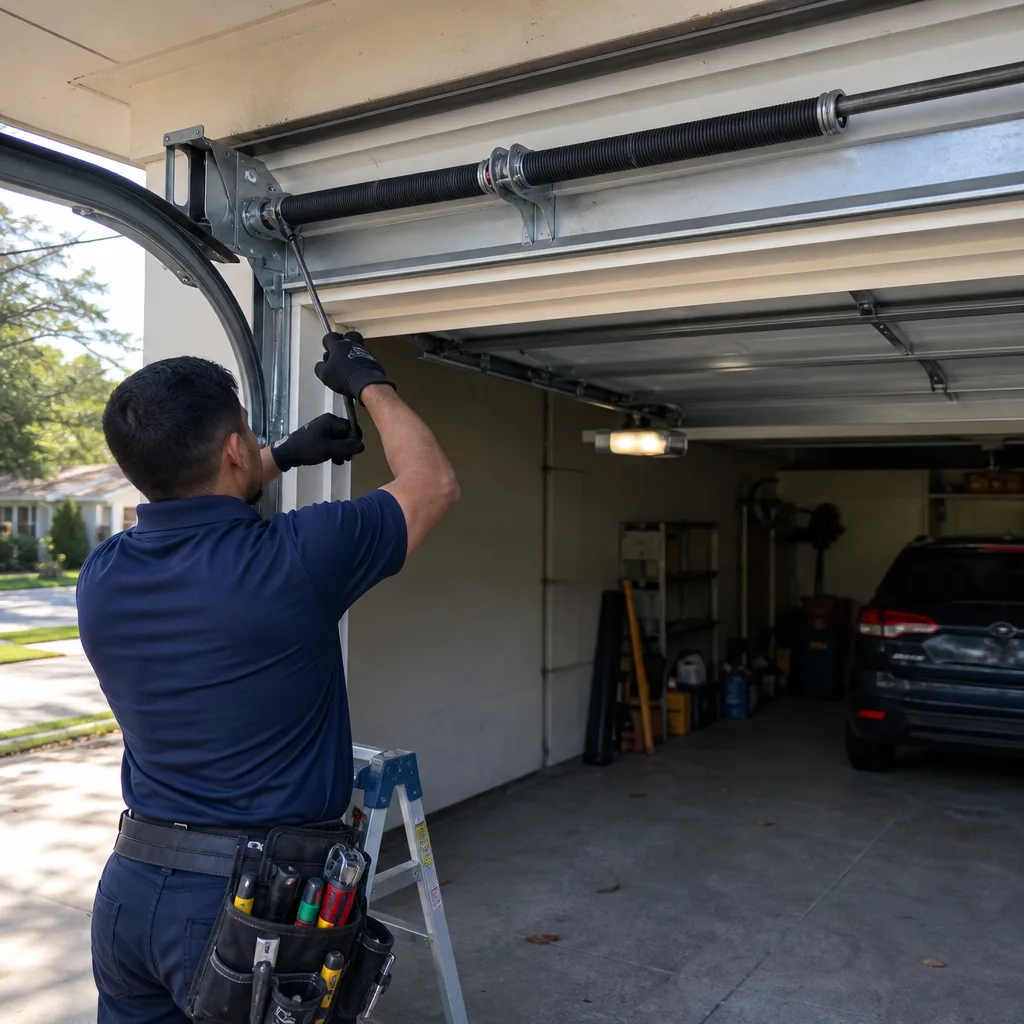
- Torsion or extension springs - the counterbalance mechanism that does 90% of the lifting. Torsion springs sit on a shaft above the door opening; extension springs run along the horizontal tracks. This distinction matters enormously for labor cost.
- Cables - the braided steel lines that connect the bottom brackets to the spring system. Cables fray before they break, and a broken cable under load is dangerous.
- Drums - the grooved spools at each end of the torsion shaft that wind and unwind the cables as the door moves.
- Bottom brackets - the steel fixtures bolted to the lowest panel that hold the cable ends. They’re under constant tension.
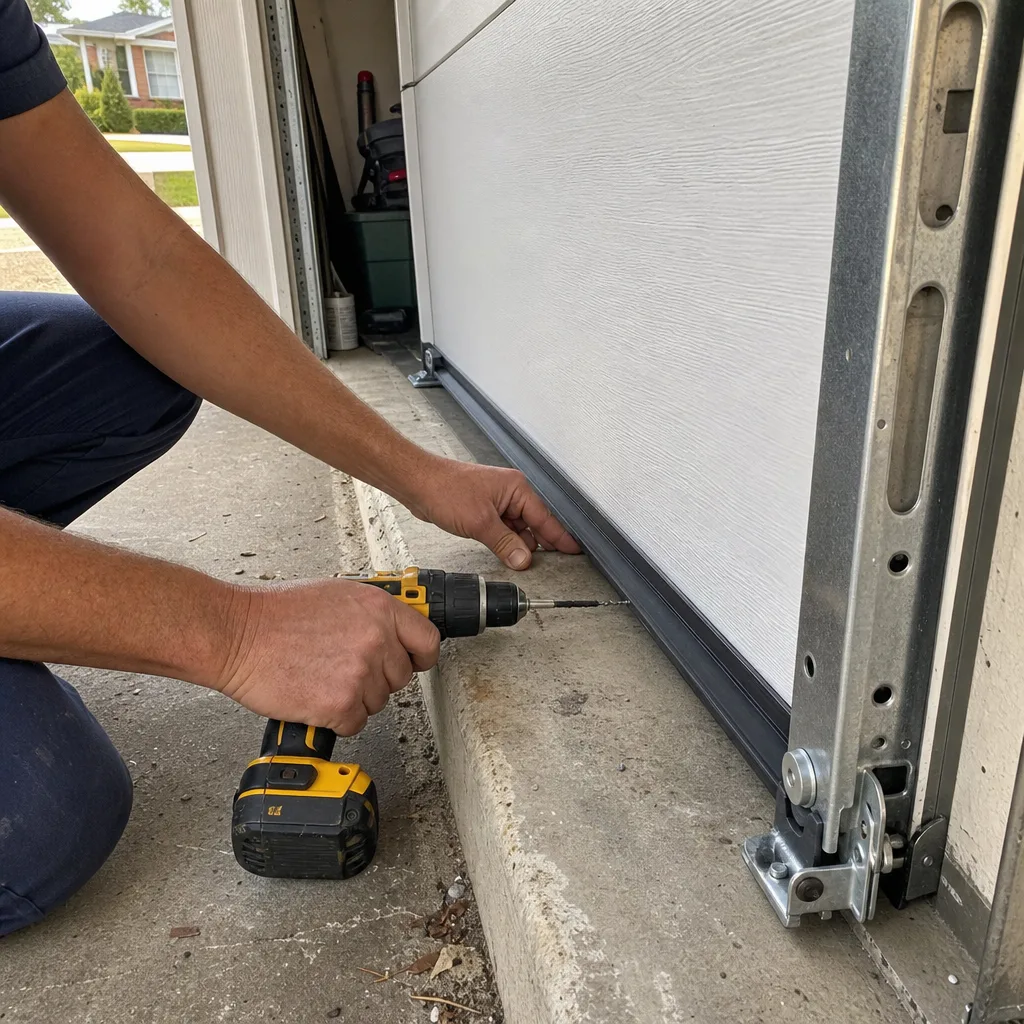
- Weather seal - the rubber or vinyl strip along the bottom of the door and the perimeter frame. In Sandy Springs, these degrade faster than national averages due to humidity and clay soil moisture.
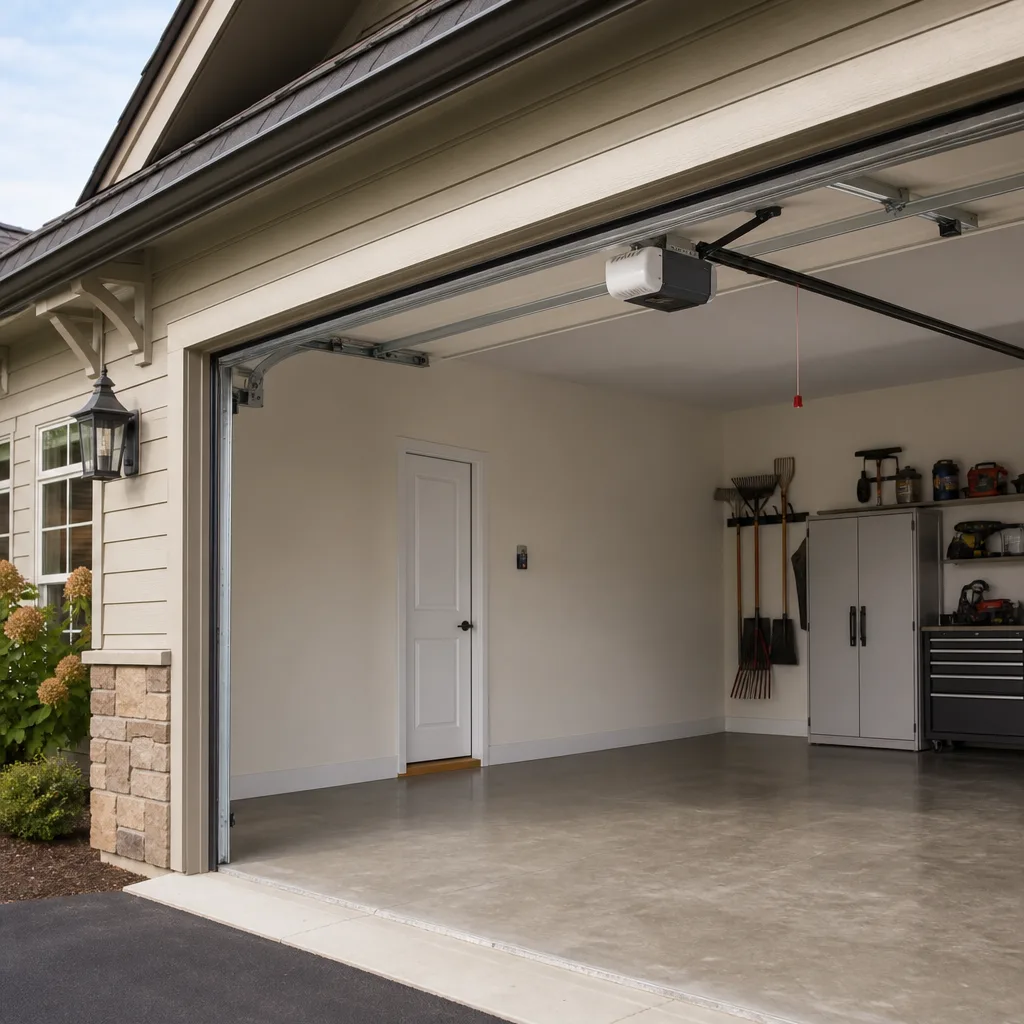
- Opener - the motorized unit that pulls the door along the track via a chain, belt, or screw drive. It contains the logic board, limit switches, and the trolley carriage.
- Safety sensors - the photo-eye units mounted 6 inches off the floor on each side of the door opening. They reverse the door if something crosses the beam while it’s closing.
In our experience across Sandy Springs, the parts homeowners never know by name until they fail are the torsion spring, the bottom bracket, and the logic board. Those three account for roughly 60% of the repair calls we run between Sandy Springs, Dunwoody, and Roswell. The good news is that none of them fail silently. They give warning signs, which the lifespan section covers.
Torsion vs. Extension Springs: Why This Distinction Changes Your Quote
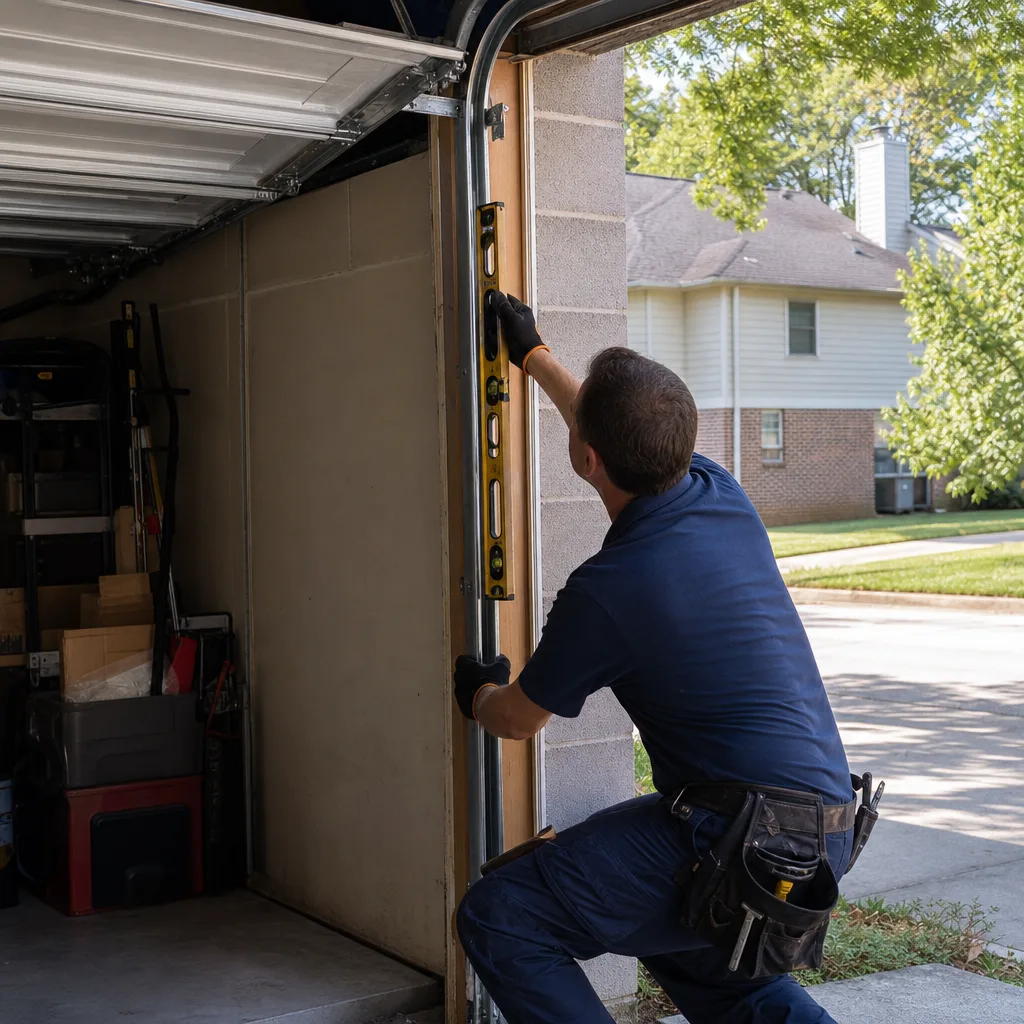
Most Sandy Springs homeowners don’t know whether they own a torsion system or an extension system until one of them breaks. The distinction is not academic. It changes the labor quote, the safety profile, and the long-term reliability of the door. Here’s the plain-language breakdown.
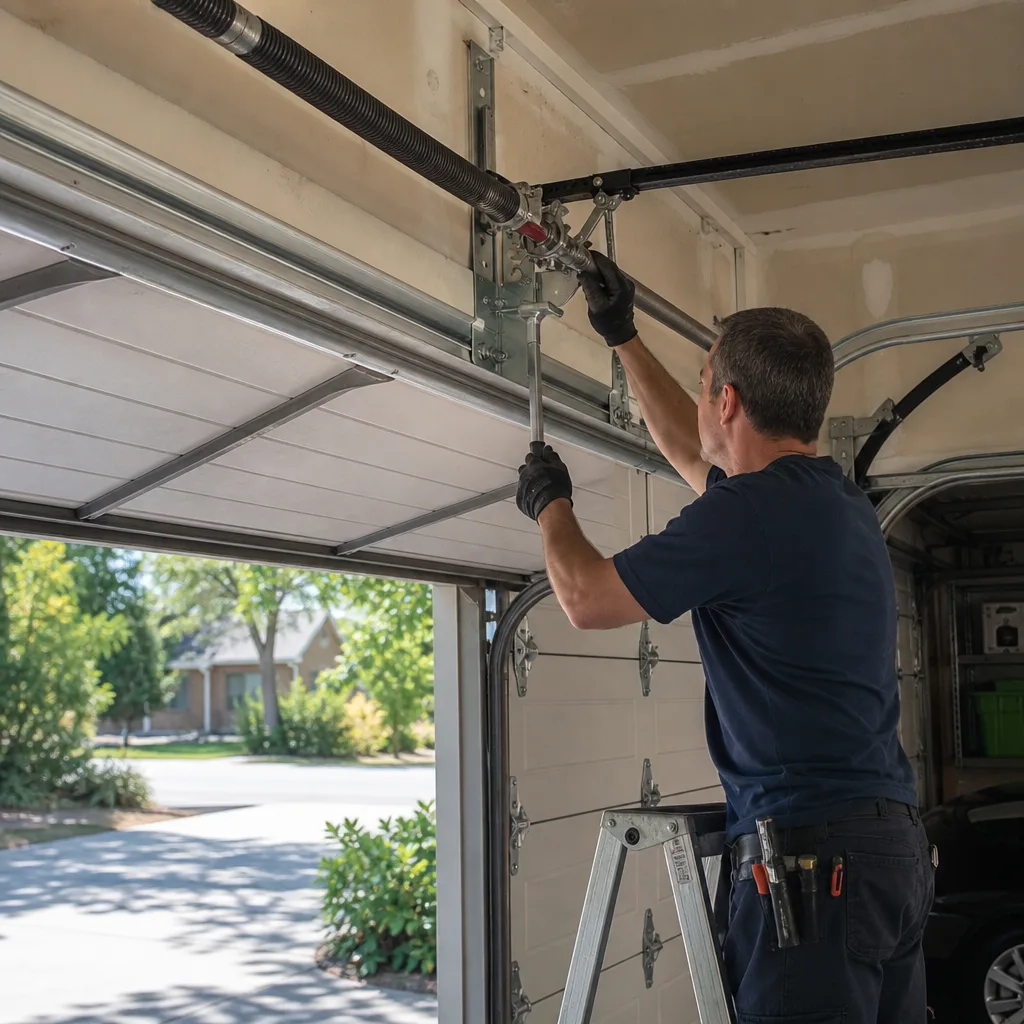
Torsion springs are mounted on a steel shaft directly above the closed door. They store mechanical energy by twisting, not stretching. When the door opens, the spring unwinds and releases torque. When it closes, the spring winds back up. This is the system installed on nearly every garage door built after 1995 and on every door we install in Sandy Springs today. Torsion springs are measured by wire diameter, inside diameter, length, and wind direction. A spring sized for a 16-by-7 door in Sandy Springs typically uses 0.225 to 0.250-inch wire.
Extension springs run horizontally along the track on each side of the door. They stretch to store energy. You’ll find them on older Sandy Springs homes, particularly in the Huntcliff and North Springs neighborhoods where many houses date from the 1970s and 1980s. Extension springs are cheaper to install but fail more violently, and they lack the containment advantage of a torsion shaft. A broken extension spring can send a steel coil flying across the garage. For that reason, building codes in most jurisdictions, including Georgia, require safety cables running through the center of extension springs to catch them if they snap. See Garage Door Permits, Codes & Inspections in GA: What You Need to Know for details on local requirements.
Why does this change your quote? Two reasons. First, torsion spring replacement requires more labor: the technician has to unwind the old spring, remove it from the shaft, measure it precisely, install the new spring, and wind it to the correct number of turns. Extension spring replacement is simpler and faster. Second, torsion springs are sold in pairs and sized to the exact door weight and height, which means parts cost is higher. A fair Sandy Springs price for a standard torsion spring replacement in 2026 runs $180 to $340 per spring installed, while an extension spring replacement runs $120 to $200 per pair. For fuller context on pricing, see our Garage Door Cost Breakdown: The Sandy Springs Homeowner’s Reference for 2026.
If you don’t know which system you have, look above your open garage door. If you see a spring mounted on a metal shaft running across the top of the opening, it’s torsion. If you see springs stretching along the horizontal track on each side, it’s extension. That single observation tells you which replacement cost range applies before you make a single phone call.
How Sandy Springs Soil and Humidity Accelerate Door Wear
Sandy Springs sits on Georgia red clay, and that clay expands and contracts with moisture far more than sandy or loamy soil. Garage slabs in this city shift seasonally. When the slab shifts even a quarter inch, the door tracks shift with it. The result is a door that binds, scrapes, or hangs unevenly, and the failure looks like a “door problem” when it’s actually a foundation-to-track alignment issue.
Humidity compounds the wear. Sandy Springs averages 65% to 75% relative humidity during summer months. That moisture attacks three parts:
- Rollers - steel roller bearings rust and seize within 5 to 7 years here, compared to 8 to 10 years in drier markets. Nylon rollers with sealed bearings mitigate this and are worth the upgrade.
- Bottom seals - the rubber strip along the bottom edge wicks moisture from the slab and degrades faster than national averages. We see cracked, flattened bottom seals on doors that are only 4 or 5 years old in Sandy Springs.
- Hinge pins and springs - surface rust forms on exposed steel within 18 to 24 months if parts aren’t lubricated. Rust doesn’t typically cause failure, but it accelerates wear on bearing surfaces.
There’s a practical implication here. The maintenance schedule a national website recommends may not match Sandy Springs reality. If your garage is in Riverside, the Heards Ferry corridor, or anywhere near the Chattahoochee floodplain, plan to lubricate rollers and hinges every 6 months, and expect to replace the bottom seal every 3 to 5 years rather than the 7 to 10 you might read elsewhere.
What a Written, Pre-Work Price Disclosure Should Contain
Here is the standard we hold ourselves to, and the standard you should hold any company to before they touch your door. A verbal estimate is not a substitute. If a technician quotes you a number over the phone or in your driveway without putting it on paper, you have no documentation of what was agreed. When the invoice shows a different number, it’s your memory against theirs.
A written price disclosure should contain these five elements, at minimum:
- The exact scope of work - what is being repaired or replaced, in specific language. “Replace torsion spring” is not enough. It should read: “Replace torsion spring, 0.250 wire, 2-inch inside diameter, 24-inch length, wound to manufacturer specification.” Specificity is documentation.
- The flat price - one number, in dollars, including parts and labor. Not a range, not “depending on what we find,” not “plus materials.” A flat number.
- Any exclusions - what’s not included. If additional parts may be needed, that should be listed separately with a maximum price.
- The warranty terms - what’s covered, for how long, and what’s excluded. Written warranty terms, not a verbal promise.
- The technician’s name and license number - so you know exactly who performed the work and that they’re state-licensed.
This is Clause 1 of The Haven Standard: a flat, written price and written scope delivered before any work starts. That clause exists because a documented price removes the leverage a technician might otherwise use in the moment. It also happens to be why Garage Door Repair in Sandy Springs works differently than what you may have experienced with other contractors.
Clause 4 of The Haven Standard is the other half of the paper trail: the technician photographs the failed component before quoting a replacement. If a company tells you a spring is broken and needs replacement, you should be shown the photograph of the clean break at the coil. If they can’t show you, ask why.
2026 Sandy Springs Repair Cost Reference Table
These are realistic labor-plus-parts ranges for common repairs in Sandy Springs in 2026, based on current market rates for this city. They’re not quotes, but they’ll tell you whether the number someone gives you is in the right universe.
- Torsion spring replacement - $180 to $340 per spring installed. Most doors have two springs; when one breaks, both should be replaced because they share the same cycle count.
- Extension spring replacement - $120 to $200 per pair installed, including safety cable.
- Cable replacement - $95 to $165 if done as a standalone repair; often $40 to $80 when bundled with spring replacement.
- Roller replacement - $90 to $160 for a full set of 10 to 12 nylon rollers. Steel rollers are cheaper, but we routinely recommend nylon in Sandy Springs humidity.
- Bottom seal replacement - $80 to $140 for residential doors, depending on door width and seal type.
- Safety sensor replacement or realignment - $85 to $140 for new sensors; realignment is typically $70 to $100 as a service call plus adjustment.
- Logic board replacement - $140 to $260, depending on opener brand. Some LiftMaster models run higher.
- Opener replacement - $350 to $650 installed for a belt-drive unit, including removal of the old opener and reprogramming of remotes and keypads.
- Track realignment - $100 to $180 per side, depending on severity.
- Service call with no repair - most Sandy Springs companies charge $50 to $90, though we apply it toward any repair performed during the same visit.
These ranges assume a standard 7-foot residential door. Eight-foot doors, carriage-style doors, and insulated double-wide doors add to parts cost. A free estimate is standard practice among reputable companies in Sandy Springs, and any price should be quoted and agreed in writing before any work begins.
Realistic Lifespans for Every Component
Every part of your garage door has a predictable lifespan. Knowing these numbers tells you when to plan for replacement, also helps you spot a contractor trying to sell you a part that should have years of life left.
- Torsion springs - rated by cycle count, not years. A standard spring is rated for 10,000 cycles, which translates to roughly 7 to 10 years for most Sandy Springs homeowners who open the door two to three times daily. Heavy use shortens that to 5 to 7 years.
- Extension springs - 6 to 9 years under normal use. They typically fail as a visible stretch rather than a snap when properly safety-cabled.
- Cables - 10 to 12 years under normal conditions, but fraying should trigger immediate replacement regardless of age.
- Rollers - steel rollers 5 to 7 years in Sandy Springs; nylon rollers 8 to 12 years.
- Hinges - 10 to 15 years. They typically fail incrementally: squeaking, then visible wear at the pin, then cracking.
- Bottom seal - 3 to 5 years in Sandy Springs humidity, as noted above. Check it every spring.
- Opener - 10 to 15 years. Belt drives last longer than chain drives. A new opener installed in 2015 is approaching end of life in 2026.
- Sensors - 8 to 12 years, but more often they fail from misalignment than from electrical failure, and misalignment is fixable in minutes.
- Panels - 20 to 30 years for steel panels with insulated cores, less for aluminum or wood composite.
- Tracks - 20+ years if not struck or bent; most track replacements happen because of foundation movement, not material failure.
One note on spring cycle ratings: a spring rated at 10,000 cycles fails at 10,000 cycles. There’s no visual warning. If you bought your Sandy Springs home in 2017 and the door has never had spring work, you’re statistically past the midpoint of your spring life. When we replace a spring, we always ask about cycle rating options because upgrading from 10k to 25k cycle springs costs a modest premium and effectively doubles or triples the life of the part.
How to Evaluate Any Garage Door Company in Sandy Springs
The research-driven homeowner reads reviews and wants the price range on the page. That’s the right instinct. Here’s how to go further and evaluate a company before they ever arrive at your door.
1. Ask for a written price before the technician arrives
Some companies can’t do this because they train technicians to size up the house and the car in the driveway before quoting. A company that operates on written, upfront pricing has no reason to wait. Clause 1 of The Haven Standard exists precisely because written prices remove the negotiation from the driveway.
2. Ask what documentation you’ll receive after the work
If the answer is “a receipt,” that’s not enough. You should receive a written warranty document and a photo record of what was found and what was done. A photo record takes two minutes to produce and exists to prove the work happened as described. It’s the difference between trusting a handshake and seeing evidence. This is Clause 4, and it’s the founding rule Servo Garage Doors Sandy Springs home was built on in 2015: photograph the failed component before quoting a replacement.
3. Ask which brands they service
A company that services LiftMaster, Chamberlain, Genie, Clopay, Amarr, Wayne Dalton, Craftsman, and Raynor has inventory depth and diagnostic breadth. A company that “mainly does one brand” may try to sell you that brand even when a repair would suffice.
4. Check the license
Georgia requires garage door technicians to be licensed. The license number should be on the company’s page and on the technician’s vehicle, not buried in fine print or “available on request.”
5. Test the phone
At 7:00 on a Tuesday evening, call the number. If you get a recording that says “please leave a message during business hours,” know that you’re one call among many. If a live person answers and can name a technician who can be dispatched, you’re talking to a company that treats emergency calls as emergencies. Garage Door Opener Repair & Installation in Sandy Springs calls, like all repair calls, are answered by a live person, 24/7, because a broken door at 9:00 PM is not a Tuesday problem. It’s a now problem.
Common Mistakes to Avoid
- Accepting a verbal estimate. A number spoken in your driveway is not a price. If it’s not written, it didn’t happen. Get the flat price and the scope in writing before any work starts.
- Replacing only one torsion spring. Springs share cycle counts. When one fails, the other is days or weeks behind it. Replacing both saves a second service call and the second labor charge.
- Ignoring a noisy door. Squeaking and grinding are diagnostics, not personality traits. A grinding noise usually means rollers or hinges are failing; correcting it early costs $100 to $200, while waiting costs a bound door and a track overhaul.
- Buying the cheapest opener available. A chain-drive opener installed in 2026 will be louder in year three than a belt-drive unit is in year ten. The price difference is roughly $100. Sandy Springs homes with bedrooms above the garage should not have chain drives.
- Lubricating with the wrong product. WD-40 is a solvent, not a garage door lubricant. It strips existing grease and accelerates wear. Use white lithium grease on hinges and a silicone-based lubricant on rollers and springs.
- Trusting “silent” reviews. When you read reviews, read the three-star ones specifically. They reveal how a company behaves when something goes wrong, which is the only time the service quality actually matters.
- Deferring a Free Second Opinion. If you have a written estimate from another Sandy Springs company, bring the paperwork. A reputable company will review it against their own assessment and tell you if the recommended work is necessary, unnecessary, or mispriced.
When to Call a Professional
Some things you can address yourself: replacing a bottom seal, lubricating rollers and hinges, realigning a photo-eye sensor that’s been knocked askew. Other things you cannot, and attempting them is dangerous. High-tension components, specifically torsion springs and cables under load, should never be serviced by anyone without proper training and tools. A torsion spring holds enough stored energy to cause serious injury if it releases unexpectedly. If a spring breaks, if a cable frays, or if the door comes off its tracks, leave the door closed, don’t operate the opener, and call a licensed technician. If the door is partially open with a broken spring, do not try to muscle it closed. The weight of an un-counterbalanced door is 150 to 400 pounds. Servo Garage Doors Sandy Springs offers free estimates in Sandy Springs. Call (470) 944-6743 and a live person answers, 24/7, including holidays.
Frequently Asked Questions
Torsion spring replacement in Sandy Springs typically costs $180 to $340 per spring installed in 2026, with most doors requiring two springs. Extension spring replacement runs $120 to $200 per pair. The exact price depends on the spring’s wire diameter, inside diameter, and length, which is why a written, measured quote matters. Call (470) 944-6743 for a free estimate with a flat, written price before any work begins.
A garage door opener in Sandy Springs lasts 10 to 15 years, with belt-drive units outlasting chain-drive units by several years. Humidity in Sandy Springs shortens the life of steel components inside the opener, particularly the limits switches and trolley carriage. If your opener was installed before 2016, plan for replacement in the next year or two.
Most Sandy Springs homes built after 1995 have torsion springs, which are safer, quieter, and longer-lasting than extension springs. If your door has extension springs, upgrading to a torsion system is a worthwhile investment, though it requires a new shaft, drums, and cables. A technician can assess your current setup and quote the upgrade as a flat written price.
Yes, emergency garage door calls in Sandy Springs are answered by a live person 24/7, including holidays, and a technician is dispatched with a named arrival time and an on-the-way text. Call (470) 944-6743 and tell us what’s happening. We’ll tell you what to check, what to avoid, and when the technician will arrive.
No. The flat price and written scope are delivered before any work starts, per Clause 1 of The Haven Standard. If additional repairs are discovered during the job, those are quoted separately and require your written approval before proceeding. The price you approve is the price you pay.
Yes. Our trucks in Sandy Springs carry torsion springs in standard sizes and cycle ratings, extension springs, cables, rollers, hinges, seals, sensors, and opener components for LiftMaster, Chamberlain, Genie, Clopay, Amarr, Wayne Dalton, Craftsman, and Raynor doors. Most repairs are completed the same visit. For Garage Door Installation in Sandy Springs, we measure, order, and schedule, with a written price delivered before the installation date.
The Bottom Line
Your garage door is a mechanical system of 11 parts, each with a predictable lifespan and a realistic repair cost. In Sandy Springs, clay soil and humidity shorten those lifespans for specific components, so maintenance schedules should be local, not generic. Before anyone works on your door, you should have a flat written price, a written scope, and a documented photo record of what was found and what was done. Marcus Deller and the team at Servo Garage Doors Sandy Springs have been working to that standard since 2015, and every estimate is free. Call (470) 944-6743.
Written by Marcus Deller, Owner at Servo Garage Doors Sandy Springs, serving Sandy Springs since 2015.